

Nepali New Year 2083 BS
Every April, Nepal begins a new year that the rest of the world has not yet counted. Rhododendrons bloom bright red across the hillsides, temple bells chime at dawn, and families meet in cosy kitchens to celebrate. To fully appreciate this event, it is essential to understand the ancient calendar and the unique civilisation that has sustained it for nearly two millennia.
This year, Nepali New Year Baisakh 1, 2083 BS, falls on Monday, April 14, 2026. Nepal follows the Bikram Sambat calendar, which is 56 years and 8 months ahead of the Gregorian calendar; the year 2026 corresponds to 2083 in Nepal.
The Bikram Sambat: A Calendar Born of Legend.
Nepal does not use the Gregorian calendar in its governmental, cultural, or civic life. Instead, it uses the Bikram Sambat (BS), a lunisolar calendar system that dates to the first century BCE. The Vikram Samvat calendar is approximately 56.7 years ahead of the Gregorian solar calendar, with Nepal’s solar Bikram Sambat beginning in mid-April. That is why visiting Nepal now implies entering the year 2083.
The Bikram Sambat calendar is more than a set of dates. It is the foundation of Nepal’s cultural life, governing festivals, harvest seasons, and numerous key rites of passage throughout the year. While this calendar is also used in parts of India, the Nepalese new year begins in mid-April with the month of Baisakh.
The calendar is named after Vikramaditya, who is thought to have created the era following his victory over the Sakas in 56 BCE. Over the ages, the system extended throughout the Indian subcontinent, eventually becoming Nepal’s official calendar.
The Vikram Samvat calendar was initially adopted as Nepal’s official Hindu calendar in 1958 VS, and it has been in use since 1901 CE. Previously, Nepal had utilised several calendar systems, including the Shaka Sambat and the ancient Nepal Sambat. Unifying the national calendar contributed to Nepal’s stronger civic identity at a time when the Gregorian system was quickly spreading throughout Asia.
Did you know? Nepal recognises three calendars.
While Bikram Sambat is Nepal’s official calendar, Nepal Sambat is also widely known and used, particularly during cultural and traditional events. Most Nepali periodicals and publications refer to both calendars, as well as the Gregorian calendar.
“Nepal is not behind the world in time; it is running its own time, a time measured not in centuries of colonialism, but in the rhythm of seasons, harvests, and sacred river cycles.”
The twelve months of the Nepali year
The Bikram Sambat year starts with Baisakh and finishes with Chaitra. Each month is closely associated with the lunar cycle and the agricultural rhythms that have moulded Nepali life for thousands of years.
What Does Naya Barsha Really Mean?
Naya Barsha (Nepali New Year) is much more than a date on the calendar. The Bikram Sambat system is more than just a way to calculate years; it is also a living legacy that passes along wisdom, tradition, and cultural identity through generations.
Most Nepalis celebrate the New Year as both an act of cultural continuity and a very personal time of reflection. In Nepal’s Hindu and Buddhist traditions, the New Year is associated with punya (holy merit), rejuvenation, and thanks. The passage from Chaitra to Baisakh is regarded as a symbolic threshold, a time to let go of past debts, grievances, and sorrows while welcoming new intentions and benefits.
The first day of Baisakh is celebrated as the Nepali New Year because it corresponds to the Hindu Solar New Year on the solar Bikram Sambat calendar. The timing is not random. Baisakh occurs during the height of spring, a period of warmth, blossoming, and abundance following the winter months. In many areas, it follows the harvest season, representing completion and rejuvenation. Nature’s cycle of rebirth reflects human rejuvenation.
Nepal is home to more than 60 ethnic groups, and the Nepali New Year is celebrated throughout the country. However, the connotation differs by community. The Newar community is deeply connected to the old Nepal Sambat tradition. It complements indigenous lunar New Year rituals in the highlands and hills. What unifies them all is the spirit of the day, which includes solidarity, thankfulness, and hope.
How does Nepal celebrate Naya Barsha 2083?
The Nepali New Year is a bright holiday marked by excitement, joy, and happiness. It is distinguished by a combination of religious ceremonies and cultural traditions. Temples and residences are cleaned and adorned, and people visit sacred sites to pray for blessings and prosperity in the coming year.
- Cleaning and Renewal of the Home
The New Year’s ritual starts several days in advance. Nepali families conduct a thorough cleaning of their homes, not just as a domestic task, but also as a symbolic act of clearing away the energy of the previous year.
Doors and windows are cleansed, courtyards are swept, and rooms are decorated with fresh seasonal flowers, torans (traditional door hangings), and rice flour rangoli patterns.
This first New Year’s tradition focuses on cleaning and decorating, representing a new beginning and the desire to put previous hardships behind.
- Temple Visits and Morning Puja
Before dawn on Baisakh 1, thousands of Nepalis travel to religious spots throughout the country. The Pashupatinath Temple, Nepal’s most revered Hindu site, attracts the most devotees.
Flowers, incense, coconuts, and diyo (oil lamps) are brought before the deities. Large crowds also congregate at other spiritual places, such as the Swayambhunath Stupa.
For many Nepalis, the early morning puja is the most sacred moment of the year.
- Family gatherings and the exchange of wishes
The Nepali New Year is celebrated with family gatherings, the exchange of well wishes, and participation in rites that are thought to bring good fortune in the coming year.
Elders are visited and acknowledged by touching their feet, which is a traditional Nepali gesture known as dhog garnu. In exchange, seniors bless the younger generation and frequently present small gifts or money.
The welcome “Naya Barsha ko Shubhakamana!” can be heard throughout the residence
Cultural Processions and Public Celebrations
Special marches in Kathmandu are organised by the Nepal Police and the Nepal Army. Tundikhel attracts large groups of locals, visitors, and dignitaries to watch these magnificent spectacles.
Throughout the day, friends, relatives, and neighbours gather to celebrate with joy and unity. Throughout the city, cultural organisations present performances of traditional Nepali music and folk dances.
- Sindoor Jatra in Thimi
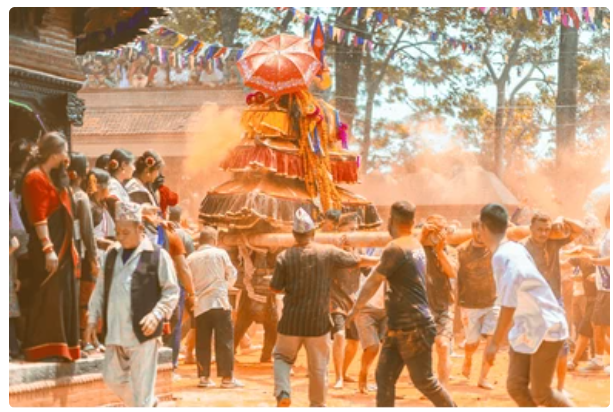
Sindoor Jatra, also known as the “Vermilion Powder Festival,” is a major aspect of Nepal’s New Year celebrations, particularly in Bhaktapur’s Thimi district.
During this colourful procession, residents clad in traditional garb carry palanquins of deities, notably Lord Bhairab, through the streets while flinging vermilion powder into the air. It represents the victory of good over evil and the coming of wealth in the New Year.
- Bisket Jatra: The Great Festival of Bhaktapur.
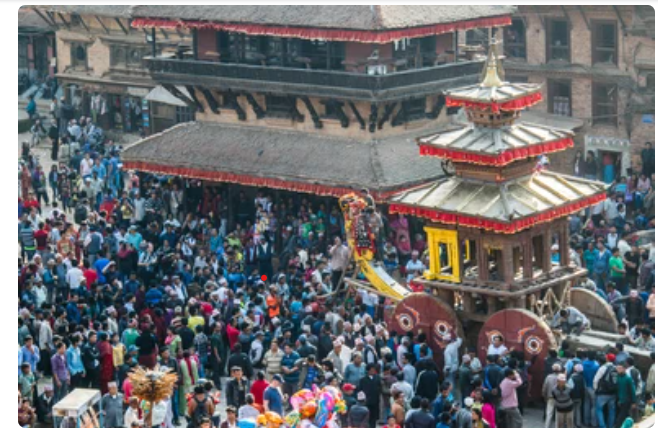
Bisket Jatra is one of Bhaktapur’s most prominent celebrations, held on Baisakh 1 and mostly observed by the Newar population. It is one of the oldest and most dramatic events in Kathmandu Valley, lasting nine days and culminating in the New Year.
The big chariot parade serves as the focal point of Bisket Jatra. Massive wooden chariots, three stories high and covered in sacred linen, transport the deities Bhairab and Bhadrakali through Bhaktapur’s narrow ancient alleyways.
Hundreds of devotees pull the chariots with thick ropes, as throngs assemble on roofs and passageways. The city is divided into two opposing groups, Upper Town and Lower Town, who compete to bring the chariot into their territory as a blessing for the new year.
- Lingo Pulling Tradition.
Another distinct Bisket Jatra practice is Lingo Pulling, which is most observed in the Bhaktapur district during the Nepali New Year.
Devotees assemble to raise a tall wooden pole known as the “lingo.” Erecting it vertically represents the triumph of life over death and the rebirth of spiritual force for the coming year
The Flavours of Naya Barsha: Traditional New Year Foods
Naya Barsha, like any other Nepalese event, is incomplete without food. As with Dashain and Tihar celebrations, a variety of traditional delicacies are made and shared among family and community members.
Food here is more than just joyful; each dish represents the history, character, and culture of the community it originates from.
- Sel Roti
Sel Roti is one of Nepal’s most popular festival meals, eaten on practically every significant event, including the New Year. It’s a ring-shaped sweet bread prepared from rice flour that’s deep-fried till crispy and golden brown, then eaten with tea or milk.
- Bara
Bara, a traditional Newari dish, is a thick, savoury lentil pancake that may be topped with egg or minced meat. It is a festival staple throughout the Kathmandu Valley, passed down through generations as part of the Newar culinary legacy.
A New Year for Everyone: Nepal’s Many Voices
One of the most striking characteristics of the Nepali New Year is how it celebrates the country’s unparalleled ethnic and cultural diversity. Nepal is home to over 60 ethnic groups, and the Bikram Sambat New Year is celebrated throughout the country.
Beyond the official New Year, several mountain and Himalayan cultures, including the Sherpa, Bhot people of Manang, Mustang, Upper Manaslu, Tamang, and Gurung populations, hold their own New Year celebrations in different months of the Nepalese calendar.
The Newar population in Kathmandu Valley preserves some of the oldest traditions, including the spectacular chariot processions of Bisket Jatra and the traditional singing of Dapha music in temple courtyards. Shankhadhar Sakkhwa created Nepal Sambat, the Newars’ traditional New Year, in 879 AD. In 2026, Nepal Sambat will be in its 1146th year.
In the central hills, Brahmin and Chhetri communities celebrate Baisakh 1 with early morning river baths, visits to clan deities, and lavish family banquets. In the Terai, the Maithili and Tharu communities incorporate their own folk traditions into the festival.
People from various ethnic and religious backgrounds gather across Nepal to establish community relationships and preserve the country’s unique cultural legacy.
“In a country of more than 60 languages and countless traditions, Baisakh 1 is one of the rare days when all of Nepal turns to face the same direction, toward the new.”
How to greet someone in Nepali on the New Year?
The most popular greeting for the New Year is:
“Naya Barsha ko Shubhakamana!” (नया वर्षको शुभकामना!)
In Newari, you may say:
“Nhū Dūne Shubhakamana.”
Even learning a few Nepali words would delight the locals and foster pleasant relationships during your vacation.
Experience Naya Barsha from the trail
If you’re hiking in Nepal around April 14th, you’ll celebrate the New Year no matter where you are. Mountain villages in the Langtang Valley, Annapurna, and Everest regions commemorate Baisakh 1 with community gatherings, traditional music, and shared feasts.
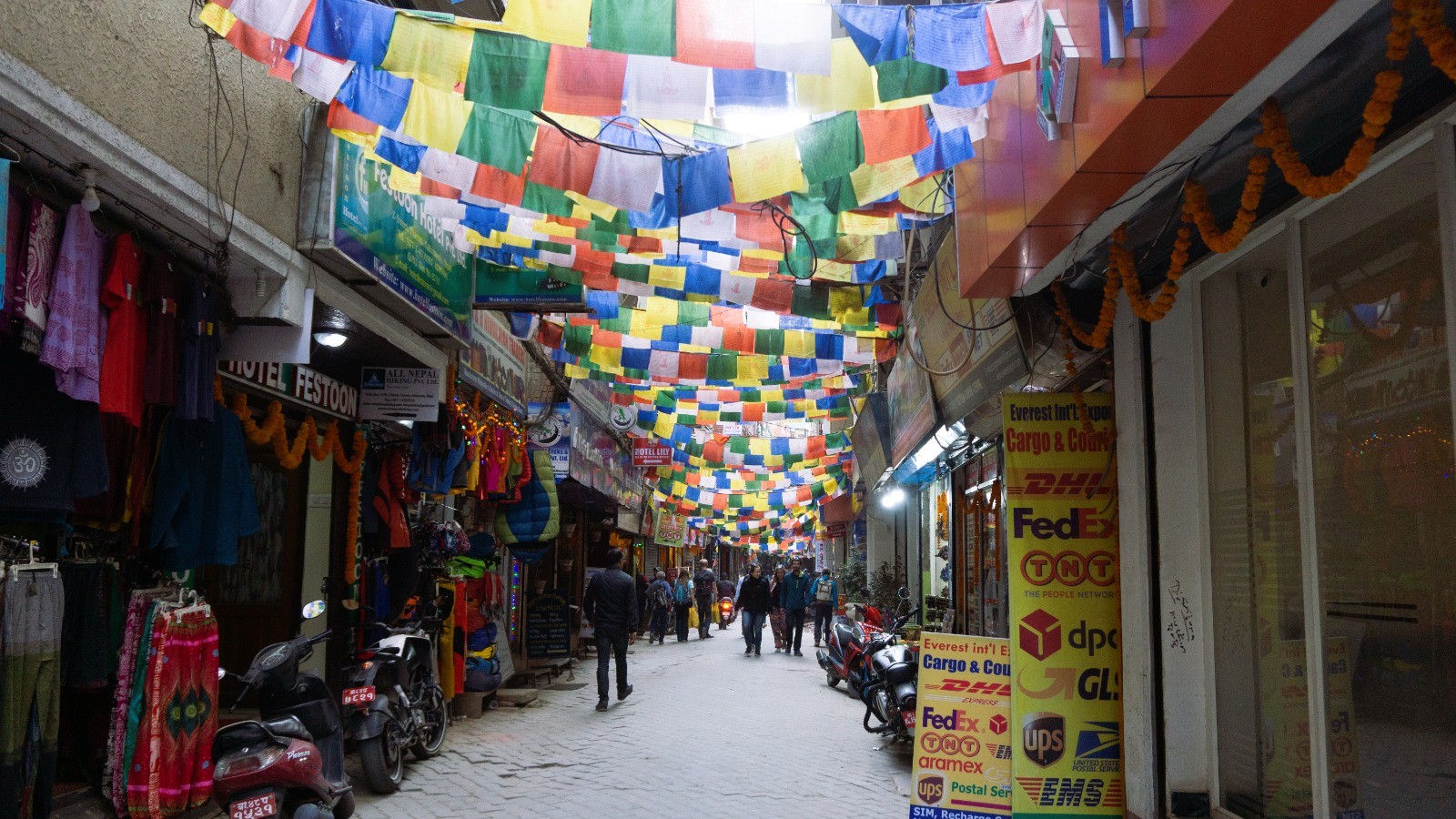
Teahouse owners frequently hang new prayer flags, and Nepal’s already legendary hospitality becomes even more welcoming during Naya Barsha. There is no need for a special schedule; merely being in Nepal at this time will allow you to enjoy the spirit of the New Year.


